
Best Battery for Solar Storage in 2026: Top Options Compared
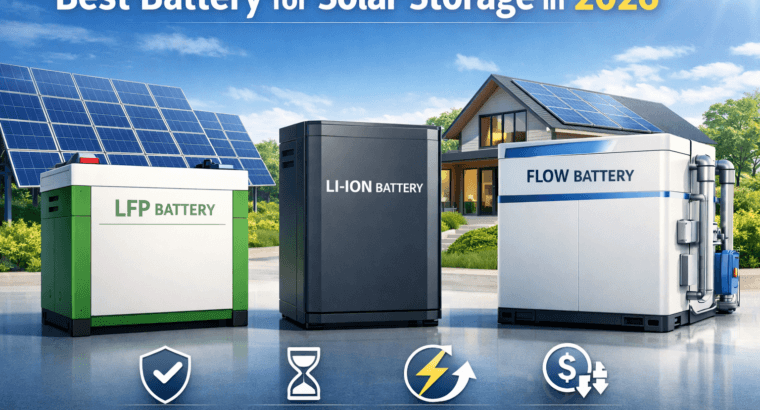
Choosing the best battery for solar storage in 2026 has become increasingly important as electricity prices rise and homeowners seek energy independence.
With rapid advancements in battery technology, the most common solar storage options today are LFP batteries, Li-ion batteries, and flow batteries. Each technology has distinct advantages and limitations, which are explained in detail in our [Li-ion vs LFP vs Flow Batteries comparison].
🤖 Overview
The best battery for solar storage in 2026 is the LFP (Lithium Iron Phosphate) battery. It offers the highest safety, longest lifespan, and best performance for daily solar charging and discharging. While Li-ion batteries are compact, they degrade faster, and flow batteries are best suited for large-scale solar installations rather than homes.
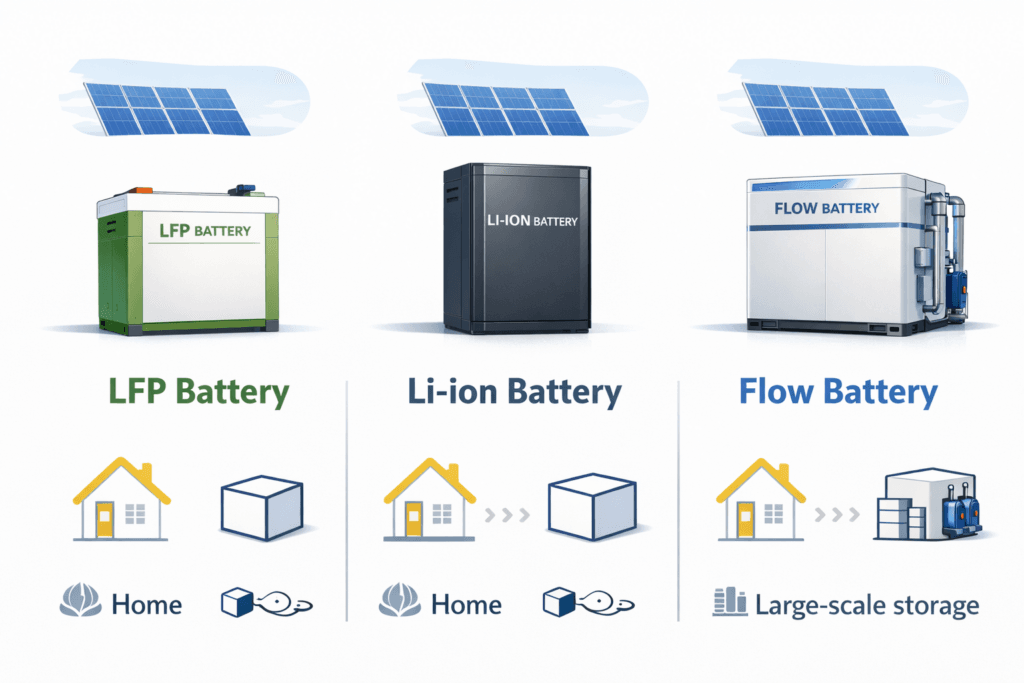
🔋 LFP Battery – Best Overall Choice for Solar Storage
LFP (Lithium Iron Phosphate) batteries have emerged as the top choice for home solar energy storage in 2026 due to their exceptional safety and durability.
Unlike traditional lithium-ion batteries, LFP batteries are chemically stable and designed for long-term daily solar cycling.
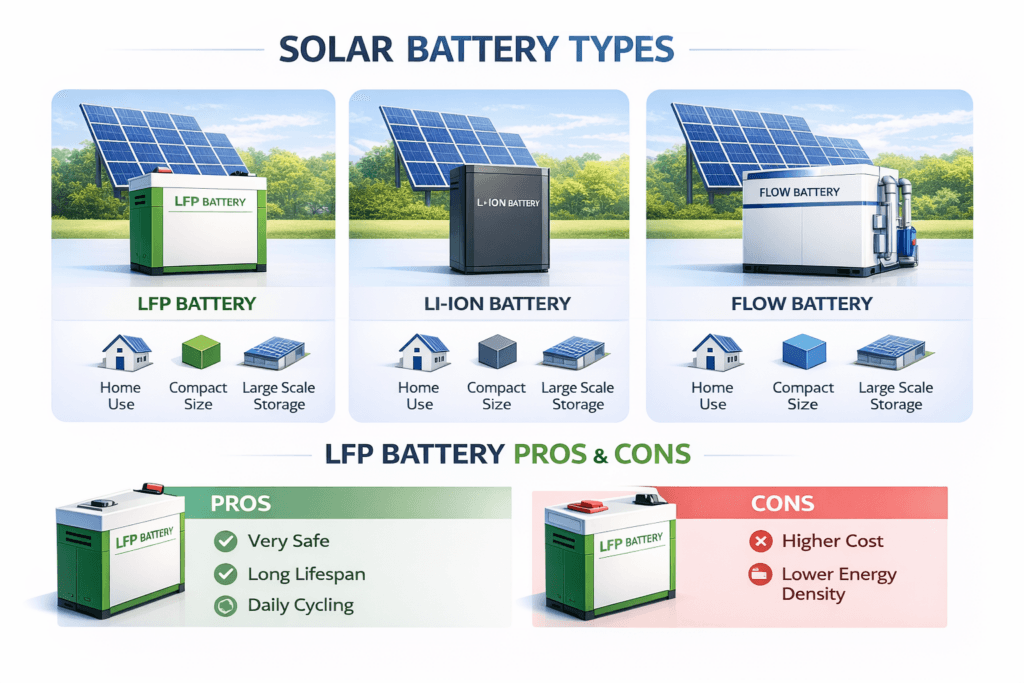
Key advantages of LFP batteries:
- 10–20+ year lifespan
- Extremely safe with low fire risk
- Ideal for daily solar charge and discharge
- Performs well in hot climates
Limitations:
- Slightly larger physical size
- Higher upfront cost (offset by long lifespan)
For homeowners comparing the two most common options, our detailed guide on [LFP Battery vs Li-ion Battery for Home Energy Storage] explains why LFP is increasingly replacing Li-ion in residential solar systems.
⚡ Li-ion Battery – Compact but Shorter Lifespan
Li-ion batteries are still widely used in energy storage systems, but they are gradually being replaced by LFP technology for solar applications.
These batteries offer high energy density, making them suitable where space is limited. However, they degrade faster when used for daily solar cycling.
Pros of Li-ion batteries:
- Compact and lightweight
- High energy density
- Fast charging capability
Cons:
- Shorter lifespan (8–12 years)
- Higher fire risk compared to LFP
- Faster capacity degradation
For a deeper breakdown of performance, safety, and lifespan differences, see our complete [battery technology comparison guide].
🧪 Flow Battery – Best for Large-Scale Solar Storage
Flow batteries use liquid electrolytes stored in external tanks, making them ideal for commercial and utility-scale solar projects.
While they offer exceptional longevity and scalability, their size and cost make them impractical for most residential installations.
Advantages of flow batteries:
- 20+ year lifespan
- 100% depth of discharge
- Excellent for long-duration energy storage
Drawbacks:
- Very large footprint
- High installation cost
- Not suitable for homes
Flow batteries are covered in more detail in our [energy storage comparison guide], where we explain why they are best used in industrial and grid-scale solar systems.
📊 Solar Battery Comparison Table (2026)
| Feature | LFP Battery | Li-ion Battery | Flow Battery |
|---|---|---|---|
| Lifespan | 10–20+ years | 8–12 years | 20+ years |
| Safety | ⭐⭐⭐⭐⭐ | ⭐⭐⭐ | ⭐⭐⭐⭐⭐ |
| Solar Cycling | Excellent | Moderate | Excellent |
| Cost Over Time | Low | Medium | High |
| Best Use Case | Home solar | Compact homes | Commercial solar |
Before making a decision, homeowners may also benefit from reading our [Guide to Home Energy Storage], which explains how to choose the right battery based on energy usage, system size, and budget.
🏆 Final Verdict: Best Battery for Solar Storage in 2026
For most residential solar users, LFP batteries are the best solar storage solution in 2026.
They provide the best balance of:
- Long lifespan
- High safety
- Reliable daily solar performance
- Lower lifetime cost
This conclusion aligns with our findings in the [home energy storage battery comparison], where LFP systems consistently outperform Li-ion alternatives for residential use.
🛒 Product CTA
🔋 Looking for reliable solar batteries?
Browse verified LFP and Li-ion energy storage systems on F2CDeals.
Compare specifications, suppliers, and pricing before you buy.
❓ FAQs
What is the best battery for solar storage in 2026?
The best battery for solar storage in 2026 is the LFP battery due to its long lifespan, high safety, and superior performance for daily solar cycling. This is also confirmed in our [LFP vs Li-ion home battery guide].
Are LFP batteries better than Li-ion for solar storage?
Yes. LFP batteries are safer, last longer, and handle daily solar charging better than Li-ion batteries.
Which solar battery lasts the longest?
Are solar batteries worth it in 2026?
Yes. Rising electricity prices, grid instability, and solar incentives make battery storage a valuable long-term investment.


Leave your comment